It’s Not Too Late: Why Late Summer Is a Great Time to Start Your Outdoor Living Space
HARDSCAPE GUIDE By Defining Lines Landscape & Hardscape | Serving Southern Maine
Retaining walls work hard — holding back soil, managing runoff, and preventing erosion. But in Maine, they face conditions that push them harder than almost anywhere else: relentless freeze-thaw cycles, heavy snowmelt, and the constant pressure of shifting ground.
Eventually, most retaining walls show signs of wear. The question is: do you repair it, or replace it entirely? Getting that decision wrong is expensive. Patching a wall that's fundamentally failing just delays a bigger problem. Replacing one that only needed targeted repairs is money down the drain. At Defining Lines, we help Southern Maine homeowners make this call every season.
Why Maine Is Especially Hard on Retaining Walls
Before weighing repair against replacement, it helps to understand what our climate does to retaining walls over time.
Freeze-thaw cycling is the primary culprit. Water works its way into small voids in mortar joints, behind stone faces, or into the compacted base. When it freezes it expands; when it thaws it contracts. Hundreds of cycles over the years, and even a well-built wall begins to move, crack, and shift.
Hydrostatic pressure — the buildup of water behind a wall — is another relentless force. If original drainage was inadequate or has clogged, water has nowhere to go and pushes outward constantly, causing walls to bow, lean, or fail entirely.
Frost heave pushes a wall's base upward during hard freezes, then lets it settle back in spring — but rarely in exactly the same place. Over time, this movement causes real displacement and structural instability.
Understanding these forces explains why some repairs are meaningful, and others are purely cosmetic.
Signs Your Retaining Wall Needs Attention
Not all wall problems are equal. Here's what to look for — and what each symptom is actually telling you.
Minor Concerns — Repair Territory
Surface cracking in mortar joints Small hairline cracks between stones or blocks, without significant movement of the stones themselves, can often be repointed. This is routine maintenance on older mortared walls.
Isolated stone displacement One or two stones shifted or fallen out while the rest of the wall stays stable is often a straightforward fix — especially if the cause (tree root, burrowing animal, localized frost heave) can be identified and addressed.
Minor surface erosion or staining Efflorescence (white mineral deposits on stone or block) and surface staining are cosmetic issues. Cleaning and sealing can address these without structural work.
Settled capstones..: If capstones have shifted slightly but the body of the wall remains plumb and stable, resetting them is typically a simple fix.
Serious Warning Signs — Replacement Territory
Leaning or bowing, a wall that has visibly tilted or bulges outward is under active structural stress. This is almost never a repair situation — the wall has moved because something fundamental has failed. Attempting to push it back rarely holds.
Multiple or widespread cracking. Isolated mortar cracks are manageable. Cracks running through stones or blocks themselves — especially diagonal or step cracks — indicate structural movement throughout, not just surface wear.
Wall sections separating from each other, from corners, or from adjacent structures mean the wall is failing as a unified system. This requires starting over.
Water is pooling behind or at the base. Failure or absence of drainage is the cause. Even if the wall still looks okay, unchecked hydrostatic pressure will eventually win. Properly fixing drainage usually means removing and rebuilding the wall with a correctly installed drain system behind it.
Significant base failure or undermining. If frost heave, erosion, or poor original construction has compromised the base, patching the wall above it is futile. The base is the foundation of everything.
Failing dry-laid walls with significant movement. Dry-laid stone walls depend on proper weight distribution and a well-compacted base. When they begin to shift or collapse significantly, they need to be fully dismantled, the base re-established, and the wall re-laid.
The Hidden Cost of "Band-Aid" Repairs
We see it regularly: a homeowner patches a leaning wall with new mortar or rearranges fallen stones, only to call us two years later when the wall has moved further or collapsed entirely. In the meantime, eroding soil has damaged adjacent landscaping, a driveway, or a foundation.
If a wall is structurally compromised, delaying proper intervention doesn't save money — it usually significantly increases the final cost.
A useful rule of thumb: if the failure is localized and the cause is identifiable and addressable, repair makes sense. If the failure is structural, systemic, or drainage-related, replacement is almost always the right answer.
What Goes Into a Proper Retaining Wall Replacement
When replacement is the right call, a quality rebuild isn't just swapping out materials. A retaining wall that lasts in Maine's climate requires:
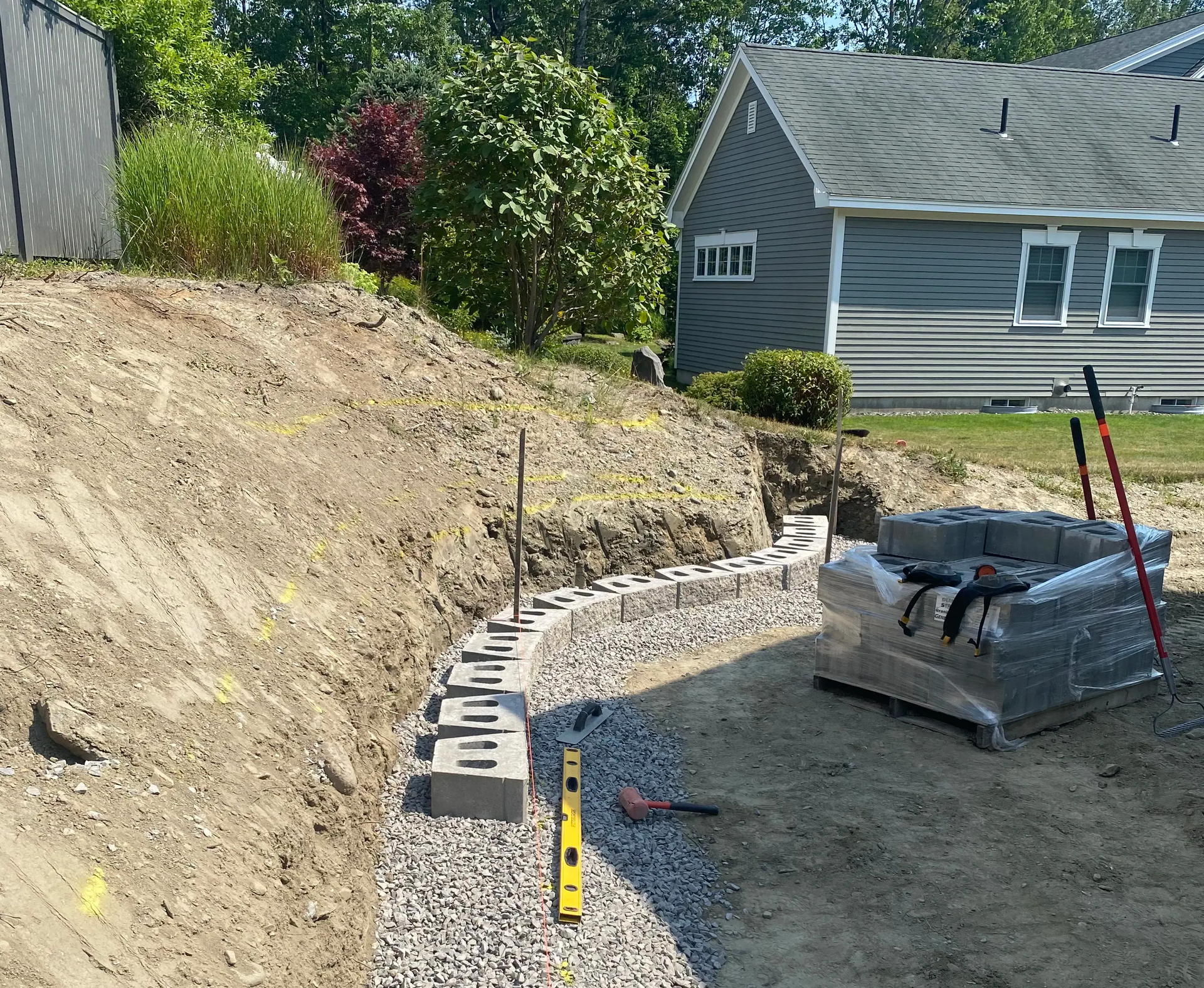
Proper excavation and base preparation. The existing wall and backfill are removed, and the base is excavated to stable ground. A compacted gravel base is established at the correct depth for frost protection.
Drainage installation. A perforated drain pipe and gravel drainage layer are installed behind the wall before backfilling. This is the single most important factor in long-term performance — and the element most often skipped in poor-quality installations.
Appropriate material selection. Natural stone, segmental retaining wall blocks, and concrete blocks each have distinct applications, aesthetics, and performance characteristics. The right choice depends on wall height, loading conditions, and your home's design.
Proper batter (wall lean) Most retaining walls should be built with a slight backward lean into the slope they're retaining. This counteracts the outward pressure of retained soil and significantly improves long-term stability.
Geogrid reinforcement for taller walls.:. Walls over 3–4 feet typically require geogrid — a mesh material embedded in horizontal layers in the backfill — to tie the wall into the slope and distribute pressure.
How We Assess Retaining Walls at Defining Lines
When a homeowner calls us about a wall they're concerned about, here's our process:
- Visual inspection from the front and back — We assess the degree of lean, cracking, displacement, and visible drainage issues.
- Base and soil assessment — We look at how the wall was originally built, what the soil conditions are, and whether there's any sign of undermining.
- Drainage evaluation — We determine whether water is being properly managed behind the wall or building up.
- Honest recommendation — We tell you what we actually find, not what generates the most revenue. Sometimes that's a targeted repair. Sometimes it's a full rebuild. Sometimes it's "monitor this for another season."
A leaning or cracked retaining wall doesn't always fail dramatically — but when it does fail completely, it can happen suddenly and cause significant collateral damage to landscaping, hardscaping, drainage systems, and in severe cases, structures. The time to act is when you notice the early warning signs, not after collapse.
Ready for a Professional Assessment?
If your retaining wall is showing signs of trouble, Defining Lines Landscape & Hardscape is ready to help. We'll give you an honest evaluation and, if work is needed, build it right the first time — with the drainage, base prep, and craftsmanship that Maine's climate demands.
Contact us today for a free consultation. 📞 (207) 650-1358 ✉️ defininglines.landscaping@yahoo.com 🌐 defininglinescustomlandscape.com/contact
Serving all of Southern Maine
Ready to paste straight into Squarespace, Wix, or WordPress. Would you like the meta description for this post too?